
Curtains are one of those home details that can completely change how a room feels. They soften natural light, add privacy, complement your furniture, and bring the entire interior together. Whether you are decorating a new apartment in Abu Dhabi or refreshing your family home, properly installed curtains can make a noticeable difference.
But here is something many homeowners discover only after purchasing their curtains: choosing beautiful fabric is just one part of the job. Getting the measurements right, selecting suitable curtain rods or tracks, installing the brackets securely, and allowing the fabric to hang correctly are equally important.
A curtain that is too short, unevenly mounted, or difficult to open can affect both the appearance and everyday comfort of your room.
The good news? With the right preparation and a little attention to detail, curtain installation becomes much easier.
In this guide, we will walk you through everything you need to know about hanging curtains, from choosing the right installation method to maintaining your curtains for years to come. We will also share practical tips for homes in Abu Dhabi, where sunlight, dust, and indoor cooling can influence your window-treatment choices.
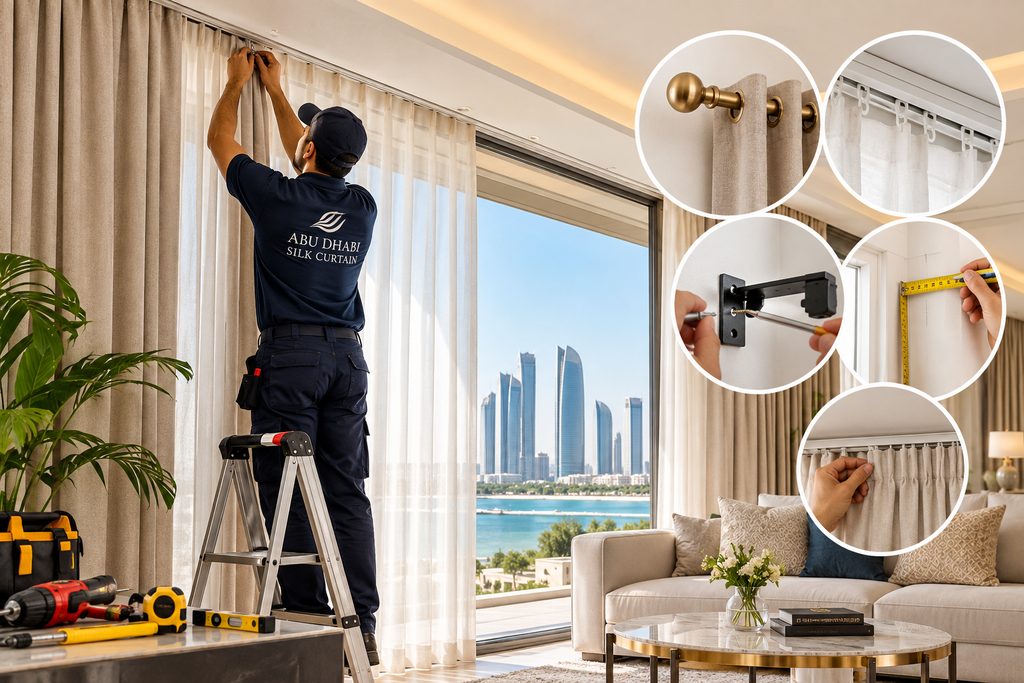
Why Proper Curtain Installation Matters
Curtains do more than cover windows. They help establish the atmosphere of a room while serving practical purposes such as privacy, light control, and creating a comfortable living environment.
However, even high-quality curtains may not look their best if they are installed incorrectly.
Proper curtain installation helps you:
- Achieve a balanced and polished appearance.
- Improve privacy without unnecessarily blocking natural light.
- Open and close curtains smoothly.
- Prevent unnecessary strain on curtain rods, tracks, and brackets.
- Create the desired visual effect, whether you want a room to feel taller, wider, or more inviting.
- Protect your investment by reducing avoidable fabric and hardware damage.
For homeowners who prefer a neat, professionally finished look, custom curtain installation can also help ensure that the fabric, hardware, and window dimensions work together.
1. Choose the Right Curtains for Your Room
Before installing anything, consider what you want your curtains to achieve.
Different rooms have different requirements. A living room may benefit from soft, light-filtering curtains, while a bedroom may need greater privacy and light control.
Sheer Curtains
Sheer curtains are lightweight window treatments that allow natural light to pass through while softening the appearance of direct sunlight.
They are particularly suitable for living rooms, dining areas, and spaces where you want a bright, airy atmosphere.
In Abu Dhabi homes, sheer curtains can help create a softer indoor environment while maintaining a connection with the outdoors.
Blackout Curtains
Blackout curtains are designed to significantly reduce incoming light when properly fitted and paired with suitable hardware.
They are commonly used in bedrooms, nurseries, and media rooms where better light control is desirable.
For bedrooms facing strong afternoon sunlight, blackout curtains can be a practical choice.
Layered Curtains
Layered curtains combine two different fabrics, commonly sheer curtains with heavier decorative or blackout curtains.
This arrangement offers flexibility throughout the day. You can enjoy filtered daylight through the sheer layer and draw the heavier curtains when you need more privacy or light control.
Layered window treatments are also an elegant option for villas, apartments, and formal living spaces.
Curtains and Drapes: What Is the Difference?
The terms curtains and drapes are often used interchangeably, but they can refer to different styles of window treatments.
Curtains are generally lighter and may be made from sheer, cotton, linen-look, or other decorative fabrics.
Drapes are often heavier and may include lining for additional coverage, structure, or light control.
The weight and construction of your chosen fabric matter when selecting curtain rods, tracks, brackets, and mounting hardware.
2. Select the Right Curtain Hanging Method
Once you have chosen your fabric, decide how you want it to hang.
The two most common options are curtain rods and curtain tracks.
Curtain Rod Installation
Curtain rods are visible decorative elements that support curtains using rings, eyelets, or compatible curtain headers.
They are available in different finishes and materials, allowing you to coordinate them with your furniture, lighting, and interior design.
Curtain rods are often suitable for:
- Living rooms
- Bedrooms
- Decorative window treatments
- Traditional and contemporary interiors
When selecting a rod, consider the combined weight of the curtains and hardware, the window width, and the number of supporting brackets required.
Curtain Track Installation
Curtain tracks provide a more discreet hanging solution.
Instead of a prominent decorative rod, the fabric moves along a track using gliders or runners.
Tracks can be installed on walls or ceilings, depending on the design and mounting requirements.
They are especially useful for:
- Floor-to-ceiling curtains
- Large windows
- Layered curtain arrangements
- Minimalist interiors
- Ceiling-mounted window treatments
Some curtain tracks are also compatible with motorized operation, offering convenient control for selected window installations.
Helpful Tip: Before purchasing a curtain rod or track, confirm that its dimensions, weight capacity, and mounting system are appropriate for your curtains and wall structure.
3. Measure Your Windows Before Installation
Accurate measurements are one of the most important parts of successful curtain installation.
Even a small measurement error can affect how the curtains sit, how much light enters around the edges, and whether the finished appearance feels balanced.
Measure the Curtain Width
Start by measuring the width of your window or the area you want the curtains to cover.
For a fuller appearance, curtain fabric generally needs to be wider than the actual window opening.
The amount of extra fabric depends on the curtain heading, fabric thickness, and desired fullness.
If you are installing two curtain panels, divide the required total width between the panels while allowing for the intended overlap at the centre.
Measure the Curtain Height
Decide where you want the curtain rod or track to sit.
Then measure from that mounting position down to your preferred curtain length.
Common curtain lengths include:
Sill Length: Curtains finish around the window sill.
Below-Sill Length: Curtains extend slightly below the sill.
Floor Length: Curtains finish just above the floor for a clean, practical appearance.
Floor-Grazing Length: Curtains lightly meet the floor for a softer decorative finish.
The best length depends on the room, furniture placement, fabric, and personal preference.
How High Should Curtains Be Hung?
Mounting curtains higher than the top of the window frame can create a taller visual appearance.
For many rooms, placing the rod or track several inches above the window frame works well, provided there is enough clearance and the mounting surface supports the hardware.
For floor-to-ceiling curtains, ceiling-mounted tracks can create a continuous, elegant look.
How Far Should Curtain Rods Extend Beyond the Window?
Extending the rod beyond the window frame allows the curtain panels to move away from the glass when opened.
This can help maximise the visible window area and allow more daylight into the room.
The appropriate extension depends on the window size, available wall space, curtain stack-back, and surrounding furniture.
Professional Tip: Always measure twice before drilling. For custom curtains, confirm the final fabric dimensions and heading style before ordering or installing the hardware.
4. Prepare the Tools and Materials
Having everything ready before you begin makes the installation process more organised.
Depending on the wall type and curtain system, you may need:
- Curtains or drapes
- Curtain rods or tracks
- Compatible brackets and mounting hardware
- Measuring tape
- Pencil or marking tool
- Spirit level
- Drill and suitable drill bits
- Screwdriver
- Appropriate screws and wall anchors
- Step ladder
- Curtain rings, gliders, or hooks where required
- Fabric steamer or iron, following the manufacturer’s care instructions
For heavier curtains, check the manufacturer’s hardware recommendations and use suitable mounting points.
If you are unsure about the wall construction, concealed services, or required fixings, professional installation is the safer option.
5. How to Install Curtain Rods Step by Step
Now that you have selected your curtains, measured the window, and prepared your tools, you can begin installing the curtain rod.
Step 1: Mark the Mounting Position
Hold the rod brackets against the wall at your chosen height.
Use a pencil to mark the fixing points.
Check that the positions allow the curtains to open properly without interfering with window handles, nearby furniture, or other fixtures.
Step 2: Check Alignment
Use a spirit level to check that the bracket positions are aligned.
This is particularly important for wide windows, where even a small difference in height can become noticeable.
For longer rods, follow the manufacturer’s instructions regarding centre support brackets.
Step 3: Secure the Brackets
Select screws and wall fixings appropriate for the wall material and the weight of the complete curtain installation.
Different surfaces, including concrete, masonry, plasterboard, and drywall, require different fixing methods.
Do not rely on ordinary screws alone where the wall construction requires suitable anchors or additional support.
Step 4: Prepare the Curtains
Before hanging, inspect the curtains for creases, loose threads, or packaging marks.
If the fabric allows, use an appropriate steamer or iron according to its care label.
Prepare the curtain rings, hooks, or eyelets according to the selected hanging system.
Step 5: Hang the Curtains
Place the curtain panels onto the rod using the appropriate hanging method.
Position the rod securely into the brackets and tighten any required locking screws.
Check that the panels are evenly distributed and that the curtains move smoothly.
Step 6: Adjust the Final Appearance
Stand back and check the curtain height, spacing, fullness, and overall alignment.
Make small adjustments where needed so the finished window treatment looks balanced.
6. How to Install Curtain Tracks
Curtain tracks are a popular choice for modern interiors because they provide a neat and relatively unobtrusive appearance.
The installation process depends on whether the track is wall-mounted, ceiling-mounted, recessed, or designed for motorized operation.
Step 1: Confirm the Track Position
Determine the correct mounting position based on the window dimensions, ceiling design, curtain length, and available fixing surface.
For ceiling-mounted tracks, check that the mounting area is suitable for the track and curtain load.
Step 2: Measure and Mark the Fixing Points
Follow the manufacturer’s recommended bracket spacing and fixing instructions.
Mark the required positions and check alignment before drilling.
Step 3: Install the Track Supports
Secure the brackets or mounting supports using fixings suitable for the installation surface.
For long or heavy curtain systems, the correct number and placement of supports are important.
Step 4: Fit the Track and Gliders
Install the track according to its supplied instructions.
Insert the appropriate gliders, runners, or curtain carriers and check that they move freely.
Step 5: Attach the Curtains
Connect the curtain hooks or heading system to the track gliders.
Distribute the fabric evenly and test the opening and closing movement.
Important: Motorized curtain tracks and complex ceiling installations may require specialist fitting and electrical work. Use a qualified professional where necessary.
7. Common Curtain Installation Mistakes to Avoid
A few simple precautions can prevent many common problems.
Incorrect Measurements
Measuring only the window glass instead of the complete intended coverage area can result in curtains that are too narrow or too short.
Always measure the mounting position and desired finished dimensions.
Choosing Inadequate Hardware
Heavy curtains require appropriate rods, brackets, and fixings.
Using unsuitable hardware may cause sagging, poor movement, or damage to the mounting surface.
Installing the Rod Too Low
A rod mounted directly against the top of the window frame may not achieve the intended decorative effect.
Consider the ceiling height and window proportions before choosing the mounting position.
Ignoring Curtain Fullness
Curtains that are too narrow may look stretched when closed.
Consider the fabric type, heading style, and desired appearance when determining the required width.
Forgetting to Check Window Clearance
Curtains should not obstruct window handles, doors, air-conditioning units, or other nearby fixtures.
Check the complete operating area before finalising the installation.
Skipping the Final Test
Always open and close the curtains after installation.
This helps identify alignment issues, stiff gliders, loose brackets, or uneven fabric distribution before regular use.
8. Curtain Care Tips for Abu Dhabi Homes
Abu Dhabi’s environment makes regular curtain care particularly useful.
Dust, strong sunlight, and indoor air-conditioning can influence how curtains look and feel over time.
A simple maintenance routine can help preserve the appearance of your window treatments.
Dust Your Curtains Regularly
Use a vacuum cleaner with a soft upholstery attachment or a suitable soft brush to remove surface dust.
Work gently and follow the fabric manufacturer’s cleaning recommendations.
Protect Curtains from Strong Sunlight
Continuous exposure to direct sunlight may gradually affect some fabrics and colours.
Where appropriate, use sheer curtains as an additional layer or select fabrics designed for your intended light exposure.
Follow the Fabric Care Label
Different materials require different cleaning methods.
Some curtains can be machine washed, while others may require professional dry cleaning or specialised care.
Never assume that all curtain fabrics can be cleaned in the same way.
Check Curtain Hardware
Periodically inspect rods, tracks, brackets, hooks, and gliders.
Look for loose fittings, uneven movement, or visible signs of wear.
Addressing small issues early can help prevent more significant installation problems.
Avoid Excessive Moisture
If curtains become damp, allow them to dry properly according to the fabric care instructions.
Good indoor ventilation can help maintain a comfortable environment and reduce lingering moisture.
Clean Curtains Before Storing Them
If you are replacing seasonal curtains or storing spare panels, clean and dry them according to their care requirements.
Store them in a clean, dry place away from direct sunlight.
9. When Should You Choose Professional Curtain Installation?
DIY installation can work well for straightforward windows and lightweight curtain systems.
However, some installations require more careful planning, specialised hardware, or professional experience.
Consider professional curtain installation when:
- You have large or unusually shaped windows.
- You are installing heavy or layered curtains.
- Your property has high ceilings.
- You need ceiling-mounted or recessed curtain tracks.
- You are installing motorized curtain systems.
- Your walls require specialised fixings.
- You want custom-made curtains fitted to precise measurements.
- You prefer a professionally finished appearance without managing the installation yourself.
Professional assistance can also be useful when replacing existing curtains, changing from rods to tracks, or coordinating multiple window treatments throughout a property.
10. Create a Beautiful Window Finish with Abu Dhabi Silk Curtain
The right curtains can bring warmth, privacy, and character to your home. But the final result depends on more than fabric selection alone.
Accurate measurements, suitable hardware, careful installation, and regular maintenance all contribute to a window treatment that looks attractive and works comfortably in everyday life.
Whether you are updating a living room, furnishing a new apartment, or planning curtains for a villa, take time to consider the fabric, hanging method, window dimensions, and practical needs of each space.
If you would like assistance with your window-treatment requirements, Abu Dhabi Silk Curtain can help you explore suitable curtain options and installation solutions for your space.
Ready to transform your windows? Contact Abu Dhabi Silk Curtain to discuss your curtain requirements and request a consultation.
A well-fitted curtain is more than a finishing touch. It is part of what makes a house feel like home.
Frequently Asked Questions About Curtain Installation
1. What is the correct height to hang curtains?
Curtains are commonly mounted above the window frame to create a balanced appearance and make the room feel taller. The ideal height depends on the ceiling, window dimensions, curtain length, and selected mounting system.
2. Should curtains touch the floor?
Floor-length curtains are a popular choice for living rooms and bedrooms. They may finish just above the floor or lightly meet it, depending on the desired appearance and practical requirements.
3. Are curtain rods or curtain tracks better?
Both options have advantages. Curtain rods provide a decorative appearance, while tracks offer a more discreet finish and are often suitable for ceiling-mounted or layered curtain arrangements. The best choice depends on your interior design and curtain requirements.
4. How much wider should curtains be than the window?
Curtains generally need additional fabric width to create attractive folds and adequate coverage. The exact amount depends on the fabric, heading style, number of panels, and desired fullness.
5. Can I install curtains on a plasterboard wall?
Curtains can sometimes be installed on plasterboard using suitable fixings and appropriate support. The correct method depends on the wall construction, curtain weight, and bracket arrangement. For heavy installations, professional assessment is recommended.
6. How do I install curtains without drilling?
Some lightweight curtain arrangements may use tension rods or other non-drilling systems, provided the window and mounting conditions are suitable. These options are not appropriate for every curtain type, especially heavy or wide installations.
7. How often should curtains be cleaned?
Cleaning frequency depends on the fabric, room conditions, dust exposure, and manufacturer’s care instructions. Regular light dust removal can help maintain curtains between deeper cleaning sessions.
8. How can I prevent curtains from fading in sunlight?
Consider suitable fabric choices, sheer layering, and appropriate window coverage. Regularly inspect curtains exposed to direct sunlight and follow the fabric manufacturer’s recommendations.
9. Can curtain tracks be installed on the ceiling?
Yes. Many curtain track systems are designed for ceiling mounting. The ceiling surface, fixing method, track design, and curtain weight must be considered before installation.
10. Is professional curtain installation worth it?
Professional installation can be particularly helpful for large windows, heavy curtains, custom-made treatments, ceiling tracks, and motorized systems. It can help ensure correct measurements, suitable hardware, and a neat finished appearance.
11. Can I install sheer and blackout curtains together?
Yes. Layered curtain systems commonly combine sheer curtains with heavier blackout or decorative curtains. A compatible double rod or double-track system allows each layer to operate independently.
12. What should I check before booking curtain installation?
Confirm your window measurements, preferred curtain style, fabric type, mounting surface, curtain length, and any nearby obstacles. If you are unsure about hardware or installation requirements, discuss them with a curtain professional before proceeding.