
Choosing the right curtains is only part of the job.
You can spend time selecting the perfect fabric, colour and design, but if the curtains are measured incorrectly or installed at the wrong height, the final result may not look the way you expected.
We’ve all seen curtains that are too short, rails that sit too low, or panels that don’t hang evenly. These small details can change the entire appearance of a room.
That’s why professional curtain installation in Abu Dhabi is worth considering, especially when you’re dealing with custom-made curtains, large windows, villas or motorized systems.
Good installation is about more than putting a curtain rod on the wall. It involves accurate measurements, suitable hardware, correct positioning and careful finishing.
And once the curtains are installed, proper care is equally important.
With regular maintenance and the right cleaning approach, good-quality curtains can continue looking fresh and well-finished for years.
Why Proper Curtain Installation Matters
Curtains affect both the appearance and practical use of a room.
When they’re installed correctly, they can:
- Hang more naturally
- Open and close smoothly
- Cover the intended window area
- Improve privacy
- Help control incoming sunlight
- Complement the room’s furniture
- Create a more finished appearance
- Work properly with curtain tracks or rods
On the other hand, incorrect installation can lead to uneven curtains, difficult movement, unnecessary fabric stress and an untidy overall appearance.
This becomes even more important with custom curtains because the fabric and measurements are made specifically for the window.
What Does Professional Curtain Installation Include?
A professional installation usually involves more than simply fitting the curtain panels.
Depending on the project, the service may include:
Window Assessment
The installation team checks the window, wall and surrounding space to determine the most suitable installation position.
Measurements
Accurate measurements are taken to determine the required curtain width and drop.
Hardware Selection
The appropriate rod, track, brackets or other hardware is selected according to the curtain type and installation requirements.
Track or Rod Installation
The hardware is securely fitted to the wall or ceiling.
Curtain Fitting
The curtain panels are attached and adjusted so they hang correctly.
Final Adjustment
The curtains are checked for alignment, movement and overall appearance.
For custom curtains, these details can make a significant difference to the final result.
How Are Curtains Measured Before Installation?
Measurement is one of the most important stages.
A curtain shouldn’t simply be measured according to the visible glass area of the window.
The required measurement can depend on:
- Window width
- Window height
- Ceiling height
- Curtain style
- Rod or track position
- Desired curtain fullness
- Floor clearance
- Whether the curtain will cover the complete wall
- Whether it is a single or double curtain setup
For example, some homeowners prefer curtains that extend from near the ceiling down towards the floor, while others want the installation to follow the window dimensions more closely.
The right choice depends on the room and the design you’re trying to achieve.
Should Curtains Be Installed on the Wall or Ceiling?
Both options can work.
Wall-Mounted Curtains
Wall-mounted rods or tracks are commonly used when there is suitable wall space above the window.
Ceiling-Mounted Curtains
Ceiling installation can create a taller, more continuous appearance and can be especially useful for large windows or full-height curtains.
Recessed or Concealed Tracks
For certain modern interiors, tracks can be positioned in a way that keeps the hardware less visible.
The best installation method depends on the architecture of the room, curtain design and hardware being used.
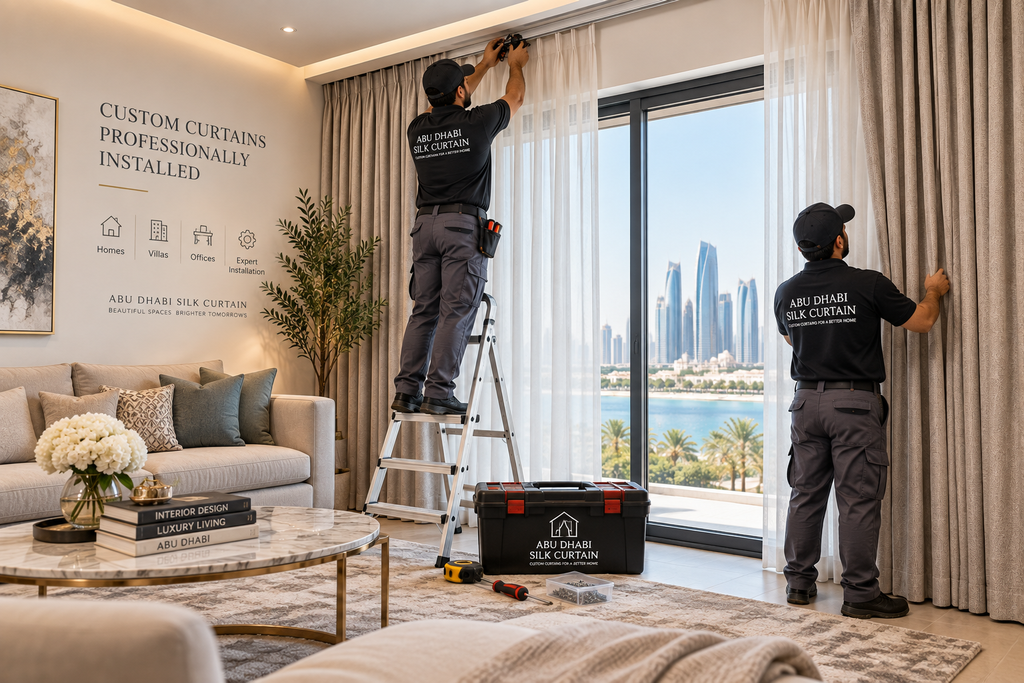
How High Should Curtains Be Installed?
There isn’t one height that works for every room.
However, curtains are often positioned above the window rather than directly on top of the window frame.
Installing them higher can create a more extended visual line and may make the window area feel more substantial.
For full-length curtains, the relationship between the track or rod and the floor is particularly important.
The curtain should generally hang neatly without excessive fabric dragging across the floor unless that look is specifically intended.
This is one reason professional measurement can be helpful.
What About Curtain Width?
Width matters just as much as length.
A curtain panel needs enough fabric to create the appropriate fullness when closed.
If there isn’t enough fabric, the curtain can look flat and stretched.
If there is too much fabric without considering the track or rod, the result can become unnecessarily bulky.
The correct fullness depends on:
- Curtain fabric
- Curtain style
- Pleat type
- Track/rod system
- Window width
- Desired appearance
Custom curtain stitching and tailoring can help achieve a more controlled finish because the curtains are prepared according to the specific measurements and design requirements.
Installing Different Types of Curtains
Not every curtain is installed in exactly the same way.
Blackout Curtains
Blackout curtains are often chosen for bedrooms, media rooms and spaces where reducing incoming light is important.
Correct installation is particularly useful because gaps around the sides or top can allow light to enter.
Sheer Curtains
Sheer curtains are lightweight and are often used to soften natural light while maintaining a bright interior.
They need to be fitted carefully so the fabric hangs naturally without looking uneven.
Silk Curtains
Silk curtains have a distinctive appearance and require careful handling.
Proper installation helps the fabric maintain its intended drape and presentation.
Motorized Curtains
Motorized curtains require additional attention because the track or motor system needs to be installed correctly.
The system should move smoothly and the curtain weight should be appropriate for the motorized track.
Professional installation is especially useful for these systems.
Bedroom Curtains
Bedroom curtains often combine privacy, light control and appearance.
A layered setup using sheer and blackout curtains can be a practical option depending on the room.
Office Curtains
Office spaces usually require a clean and functional installation.
Curtains should operate smoothly without interfering with desks, doors or other office furniture.
Common Curtain Installation Mistakes
Some installation problems are surprisingly common.
Installing the Rod Too Low
When a curtain rod is installed directly above the window, the window can appear smaller.
Incorrect Width
If the curtain is not wide enough, it may not provide the desired coverage or fullness.
Uneven Curtain Length
Even a small difference in drop can be noticeable once the curtains are hanging.
Weak Hardware
Heavy curtains require suitable rods, tracks and brackets. Using inadequate hardware can create problems later.
Ignoring Furniture
Curtains should work with the furniture and layout of the room.
A curtain that constantly catches on a sofa, bed or cabinet isn’t practical.
Forgetting About Doors
Balcony and patio doors require careful planning because the curtains need to open and close without interfering with the door.
Why Professional Curtain Installation Is Useful
Curtain installation may look like a simple DIY project, but large or custom curtains can become difficult to handle.
Professional installation can help ensure:
- Accurate positioning
- Secure hardware
- Correct curtain height
- Proper curtain alignment
- Smooth opening and closing
- Cleaner finishing
- Better overall presentation
It’s particularly useful for villas, large windows, high ceilings, full-height curtains and motorized curtain systems.
8 Practical Curtain Care Tips
1. Remove Dust Regularly
Curtains naturally collect dust over time.
Gentle vacuuming using an appropriate attachment can help remove surface dust without unnecessarily disturbing the fabric.
For delicate fabrics, follow the manufacturer’s care instructions.
2. Don’t Wait Until Curtains Look Dirty
By the time curtains visibly look dusty, they may already have accumulated a significant amount of dust.
Regular light maintenance is generally easier than trying to deal with heavy buildup later.
3. Be Careful With Washing
Not every curtain fabric should be washed in the same way.
Some curtains can be machine washed, while others may require professional cleaning.
Always check the fabric’s care instructions before washing.
This is particularly important for delicate or specialty fabrics.
4. Avoid Harsh Cleaning Products
Strong chemicals may affect the colour, texture or finish of some curtain fabrics.
Use a cleaning method appropriate for the specific material rather than applying a random household cleaner.
5. Pay Attention to Sun Exposure
Strong sunlight can gradually affect some fabrics.
If your curtains receive direct sunlight for long periods, consider using suitable window treatments or curtain layering to reduce exposure.
Blackout or lined curtains can also provide additional protection depending on the setup.
6. Check the Curtain Hardware
Don’t only look at the fabric.
Every so often, check:
- Rods
- Tracks
- Brackets
- Rings
- Hooks
- Motorized components
If something feels loose or the curtains stop moving smoothly, it’s better to address the problem early.
7. Don’t Pull Curtains Aggressively
Curtains should move smoothly along their track or rod.
Pulling them forcefully can place unnecessary stress on the fabric, hooks or hardware.
If a curtain becomes difficult to move, check whether there is an issue with the track or installation.
8. Keep Curtains Away From Moisture Where Possible
Moisture can create problems for certain fabrics and may contribute to unpleasant smells or other issues.
Rooms with higher humidity should receive extra attention when it comes to ventilation and curtain maintenance.
How Often Should Curtains Be Cleaned?
There isn’t one cleaning schedule that works for every home.
It depends on:
- Fabric type
- Room usage
- Dust levels
- Indoor air quality
- Pets
- Children
- Window location
- Exposure to outdoor air
Curtains in a frequently used living room may need more regular attention than decorative curtains in a guest room.
Instead of following a strict calendar, pay attention to the condition of the fabric and follow its specific care instructions.
There isn’t one cleaning schedule that works for every home.
It depends on:
- Fabric type
- Room usage
- Dust levels
- Indoor air quality
- Pets
- Children
- Window location
- Exposure to outdoor air
Curtains in a frequently used living room may need more regular attention than decorative curtains in a guest room.
Instead of following a strict calendar, pay attention to the condition of the fabric and follow its specific care instructions.
What About Curtain Steam Cleaning?
Steam cleaning can be suitable for some curtain materials, but it isn’t appropriate for every fabric.
Before using steam, check whether the fabric can safely tolerate heat and moisture.
If you’re unsure, professional advice is better than risking damage to an expensive curtain.
This is particularly relevant for delicate fabrics or custom-made curtains.
Caring for Blackout Curtains
Blackout curtains require some extra attention.
Their special construction can include coated or lined materials designed to reduce light transmission.
Aggressive washing or unsuitable cleaning methods can potentially affect the backing or finish.
For this reason, always follow the care instructions supplied with the curtains.
Caring for Sheer Curtains
Sheer curtains are lighter and more delicate than many standard curtain fabrics.
Dust can be visible on lighter sheer materials, so gentle regular maintenance can help.
Avoid pulling or handling the fabric roughly, especially when removing it from tracks or rods.
Caring for Motorized Curtains
Motorized curtains need both fabric care and system care.
The curtain itself should be cleaned according to its material, while the track and motor should be kept free from unnecessary dust and obstruction.
If the curtains begin moving unevenly, making unusual sounds or stopping unexpectedly, avoid forcing them manually if the system isn’t designed for it.
Instead, have the system checked.
When Should You Call a Curtain Professional?
Some curtain problems are simple enough to handle yourself.
Others are better left to a professional.
Consider professional help if:
- Curtains are hanging unevenly
- The track is loose
- Heavy curtains are difficult to move
- A curtain has been damaged
- The fabric needs specialist cleaning
- You are installing large curtains
- You need full-height curtains
- You are installing motorized curtains
- You are replacing existing curtain hardware
- You need custom curtains measured and fitted
Getting the problem checked early can often prevent a small issue from becoming a bigger one.
Professional Curtain Installation in Abu Dhabi
At Abu Dhabi Silk Curtain, curtain installation is part of a complete custom curtain service.
The process can start with understanding your room and window requirements, followed by measurement, fabric selection, curtain stitching and tailoring, and finally professional installation.
This approach means the curtains aren’t treated as a separate product that simply needs to be hung.
The measurements, fabric, stitching and installation all need to work together.
Whether you’re furnishing a villa, updating a bedroom, refreshing a living room or fitting curtains in an office, the right installation can make the finished space feel much more complete.